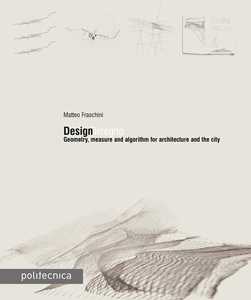
Maggioli Editore DesignDisegno. Geometry, measure and algorithm for architecture and the city
In a design process, the drawing (Italian: disegno) of an object or a space is the act of representing that thing with the idea of knowing and modifying it, and it is an essential moment. It is an operation that requires a synthesis capable of projecting and confronting on a two-dimensional surface - physical or virtual - the complexity of the world with an idea of form. The concept of measure and measurement is therefore, for the designer, the instrument that makes it possible to make an object, architecture or an urban fact representable, abstract, knowable and therefore designable. Similarly, for the user of that space, the measurement will help to memorise, map and place him in relation to it. Mathematics and geometry have played a fundamental role in enabling this knowability. The machine of the two mirrors invented by Brunelleschi opened up the definition of the rules of perspective and performed the compression of a three-dimensional world regulated by numbers, on a two-dimensional surface. He defined a bijective (one-to-one) relationship between the drawn and the real world. This operation reinforced the distinct role of the tactile and the visual dimension - the stage and the scene - and permitted to describe and graphi- cally think of infinity and the infinitesimal. Towards the end of the last century, F. O. Gehry created his “machine”, a digital tool to “see and know” what he had manually modelled in his cardboard models Mathematics as the tool that structures forms and urban spaces, making them recognisable, for centuries has organized this “invisible framework” through discrete measures, proportions and modules. Now the complexity of urban spaces can be better understood using the concept of “modality of variation”. This new framework suggests the study of algorithms capable of interpreting this dynamic modification process. These themes are addressed from a technical point of view, understood as the necessary knowledge to imagine and make an idea designable. This book is a reflection that, with the benefit of practical examples, proposes to reason on the relationship between an idea and its representation, between a sketch, analogical and digital models, and on the “mental” tools which manage this relationship. It is furthermore a reflection on the theoretical and practical implica- tions of the concept of fold, or better, on the act of folding, as a concrete and tangible capture of the infinitesimal that directs a tectonic possibility. To do this, to try and control the infinitesimal as a measure that gives structure to contemporary design, both at the architectural and the urban scale, a delving into mathematics as the algorithm that manages the machine, was necessary.\r\nThis publication is based on the doctoral dissertation in Urban and Architectural Design presented at the Politecnico of Milan and on the research and teaching activities developed by the author in that school and, subsequently, at the University of Cape Town.
★ Miglior prezzo
Rilevanza
| Negozio | Nome | Condizione | Prezzo | |
|---|---|---|---|---|
| Feltrinelli IT | Maggioli Editore DesignDisegno. Geometry, measure and algorithm for architecture and the city | Nuovo | €1700 | Vedi l'offerta |
| IBS IT | Maggioli Editore DesignDisegno. Geometry, measure and algorithm for architecture and the city | Nuovo | €1700 | Vedi l'offerta |
Dettagli
In a design process, the drawing (Italian: disegno) of an object or a space is the act of representing that thing with the idea of knowing and modifying it, and it is an essential moment. It is an operation that requires a synthesis capable of projecting and confronting on a two-dimensional surface - physical or virtual - the complexity of the world with an idea of form. The concept of measure and measurement is therefore, for the designer, the instrument that makes it possible to make an object, architecture or an urban fact representable, abstract, knowable and therefore designable. Similarly, for the user of that space, the measurement will help to memorise, map and place him in relation to it. Mathematics and geometry have played a fundamental role in enabling this knowability. The machine of the two mirrors invented by Brunelleschi opened up the definition of the rules of perspective and performed the compression of a three-dimensional world regulated by numbers, on a two-dimensional surface. He defined a bijective (one-to-one) relationship between the drawn and the real world. This operation reinforced the distinct role of the tactile and the visual dimension - the stage and the scene - and permitted to describe and graphi- cally think of infinity and the infinitesimal. Towards the end of the last century, F. O. Gehry created his “machine”, a digital tool to “see and know” what he had manually modelled in his cardboard models Mathematics as the tool that structures forms and urban spaces, making them recognisable, for centuries has organized this “invisible framework” through discrete measures, proportions and modules. Now the complexity of urban spaces can be better understood using the concept of “modality of variation”. This new framework suggests the study of algorithms capable of interpreting this dynamic modification process. These themes are addressed from a technical point of view, understood as the necessary knowledge to imagine and make an idea designable. This book is a reflection that, with the benefit of practical examples, proposes to reason on the relationship between an idea and its representation, between a sketch, analogical and digital models, and on the “mental” tools which manage this relationship. It is furthermore a reflection on the theoretical and practical implica- tions of the concept of fold, or better, on the act of folding, as a concrete and tangible capture of the infinitesimal that directs a tectonic possibility. To do this, to try and control the infinitesimal as a measure that gives structure to contemporary design, both at the architectural and the urban scale, a delving into mathematics as the algorithm that manages the machine, was necessary.\r\nThis publication is based on the doctoral dissertation in Urban and Architectural Design presented at the Politecnico of Milan and on the research and teaching activities developed by the author in that school and, subsequently, at the University of Cape Town.
Caratteristiche
Prodotto
| Nome del prodotto | Maggioli Editore DesignDisegno. Geometry, measure and algorithm for architecture and the city |
|---|---|
| Marca | Maggioli Editore |
| Serie | Libri |
| Condizione | Nuovo |
| EAN | 9788891626899 |
| MPN | 9788891626899 |
Proprietà del prodotto
| merchant_product_second_category | Arte, architettura e fotografia |
|---|---|
| merchant_product_third_category | Arte e design industriale e commerciale |
| custom_1 | Matteo Fraschini |
| custom_4 | libro |
Prezzo e disponibilità rilevati il 16/11/2026 23:18: possono variare, fa fede quanto indicato sul sito del negozio al momento dell'acquisto. Origine dei dati


