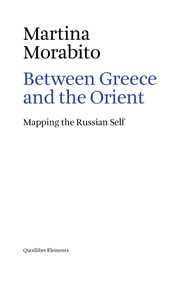
Quodlibet Between Greece and the Orient. Mapping the Russian self
«Imitating Dionysius, a primaryfigure within the Symbolistculture, this book seeks hybridand dynamic processes,co-presences, and ambivalence,tracking down the many worksin which the strict categoriesof “East” and “West,” “Classicism”and “Modernity,” “Russia”and “Europe” are reversedand reformulated into newparadigms.» The Russian Symbolist period reformulated its own cultural identityfrom a spatial point of view, shaping an imaginary place formed bythe hybridisation between Ancient Greece and the Orient: this is themain idea of this essay, that regards geographical space as a tool toread literary and cultural history in a new way. The book maps theRussian Zeitgeist – roughly from 1890 to 1917 – according to the descriptions of the “Russian Self” made by Andrej Belyj, Valerij Brjusov, Valentin Serov, Michail Vrubel’, Lev Bakst, and Dmitrij Mendeleev,just to name a few. Through an extensive use of montage and an intentionally loose application of chronological and typological definitions, the analysis reveals how Russian thought, in the syncreticSymbolist period, lays the foundations for a new Self, interpretednot as a sum of incoherent elements, but as a coherent holistic space.
★ Miglior prezzo
Rilevanza
| Negozio | Nome | Condizione | Prezzo | |
|---|---|---|---|---|
| Feltrinelli IT | Quodlibet Between Greece and the Orient. Mapping the Russian self | Nuovo | €1020 | Vedi l'offerta |
| IBS IT | Quodlibet Between Greece and the Orient. Mapping the Russian self | Nuovo | €1020 | Vedi l'offerta |
Dettagli
«Imitating Dionysius, a primaryfigure within the Symbolistculture, this book seeks hybridand dynamic processes,co-presences, and ambivalence,tracking down the many worksin which the strict categoriesof “East” and “West,” “Classicism”and “Modernity,” “Russia”and “Europe” are reversedand reformulated into newparadigms.» The Russian Symbolist period reformulated its own cultural identityfrom a spatial point of view, shaping an imaginary place formed bythe hybridisation between Ancient Greece and the Orient: this is themain idea of this essay, that regards geographical space as a tool toread literary and cultural history in a new way. The book maps theRussian Zeitgeist – roughly from 1890 to 1917 – according to the descriptions of the “Russian Self” made by Andrej Belyj, Valerij Brjusov, Valentin Serov, Michail Vrubel’, Lev Bakst, and Dmitrij Mendeleev,just to name a few. Through an extensive use of montage and an intentionally loose application of chronological and typological definitions, the analysis reveals how Russian thought, in the syncreticSymbolist period, lays the foundations for a new Self, interpretednot as a sum of incoherent elements, but as a coherent holistic space.
Caratteristiche
Prodotto
| Nome del prodotto | Quodlibet Between Greece and the Orient. Mapping the Russian self |
|---|---|
| Marca | Quodlibet |
| Serie | Libri |
| Condizione | Nuovo |
| EAN | 9788822908155 |
| MPN | 9788822908155 |
Proprietà del prodotto
| merchant_product_second_category | Società, politica e comunicazione |
|---|---|
| merchant_product_third_category | Argomenti d'interesse generale |
| custom_1 | Martina Morabito |
| custom_4 | libro |
Prezzo e disponibilità rilevati il 16/11/2026 13:15: possono variare, fa fede quanto indicato sul sito del negozio al momento dell'acquisto. Origine dei dati